
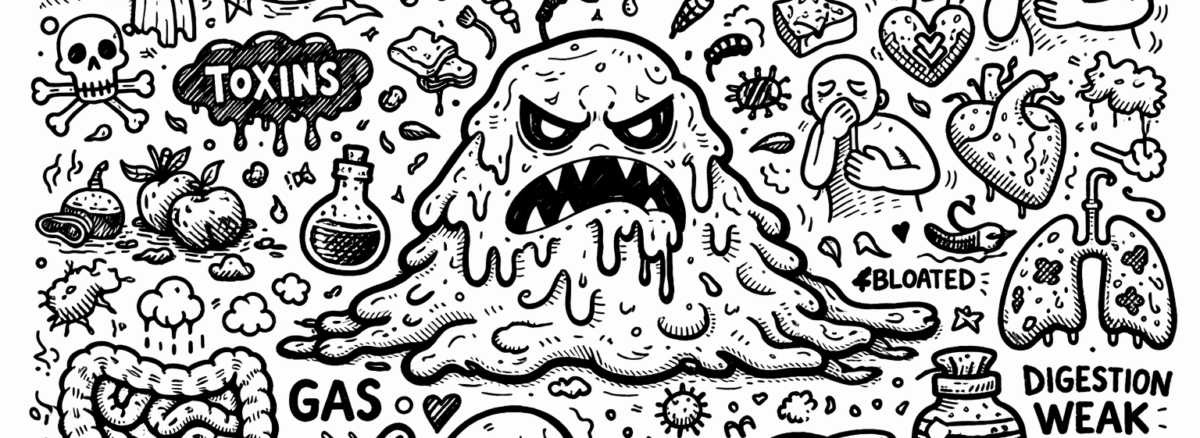
AMA
Introduction
Ama is the product of decreased digestion, coupled with excess food intake. This results in the formation of complex in the gut, which acts as poison and produces many symptoms.
Ama is one of the most discussed terms in Ayurveda. The term Amaya is a synonym of disease. It means ‘that which is caused by ama’.
Ama is a product of indigestion formed in the stomach, which tends to cause many systemic diseases.
When vitiated doshas come in association with ama they are called saama doshas. These sama doshas are very tough to handle as they produces serious symptoms and are root causes for many diseases.
Similarly sama dhatus (tissues associated with ama) and sama malas (waste substances associated with ama) too cause many diseases.
Ama, owing to its sticky nature is responsible for many blocks occurring in the cells and tissues, channels etc, causing depletion of nutrition needed for tissue functions and retention of wastes within the body. All these become responsible for many diseases, lowers the strength and immunity of an individual.
Since ama cause very dangerous symptoms similar to that of poison, it is also called as ama visha.
Nirukti, Utpatti
Derivation of The Word Ama – (Nirukti)
The word ‘Ama’ is derived form the root.
Am Roga dhatu + Aa + Dhang Pratyaya (A.K). Here the presiding vowel is elongated and the word ‘AMA” is formed.
According to Hemachandra – Gatyartha Am dhatu + Nich pratyaya = Ama (A.K)
Ama by Utapatti :
“Amyatae Gamyate pakadartham iti Amah” (A.K )
The substance which is not digested properly and needs further digestion is called Ama.
“Amayate pidyate srotasamauha aneneti Amah” (A.K.)
Substance which is detrimental to srotas is termend as Ama.
It produce pain or create pressure on Srotamukha and accumulate in Srotamukha.
“A isat amyate pachyate iti Amah” (S.K.D.) “paka rahita kancha is bhasa”
Incompletely digested or unprocessed matter is Ama.
In Ayurveda the term “Ama” means – substance which is supposed to under go digestion ( Amyate……iti amah)
The term “Ama” is a synonym of vyadhi found in Charka Nidana sthana.
“Tatra vyadhiramayo gada ……ityanathantaram” (Ch.Ni – 1)
“Prayena Ama samuthena Amaya ityuchyate” (Chakrapani)
According to Aruna datta – “kilama samutthah sarve vyadhayah”
The most part of the disease are ingendered by Ama.
AA – As a prefix to verb & noun. It means near, near to.
MA – poison
Ama denotes a substance, or a group of substance which is near to poison or act like poison.
Derivation, meaning
Derivation of the term Ama
The term Ama is pronounced as Aama. It is made up of two root words Ā + ma. In this, ‘Ā’ means towards and ‘ma’ means poison. This explains that ama is a substance which is similar to poison or poison like substance. This also explains why ama is otherwise called amavisha.
Meaning of the term Ama
Amavisha – A substance similar to poison
Ajeerna ahara or ajeerna ahara rasa – Raw, uncooked, immature, undigested and incompletely formed product of digestion of food formed in the stomach
Apakwa Annarasa – incompletely formed digestive juices
State of indigestion of food
Amaya – disease (amaya is a synonym of disease)
Mala sanchaya – accumulation of waste substances
Prathama dosha dushti – first contamination of dosha
Avipakwa dravya – that which is not processed properly
Ama definition
Definition of the term Ama
The food which has undergone acidic form, incomplete digestion is known as ama.
The substance which obstructs the channels of the body and interrupts their soft functioning is called ama.
Ama formation
What is the root cause for “Ama”?
The weak action of Agni resulting in immature undigested food which is not assimilated and is the prime cause for diseases is Ama.
A few scholars consider indigested and improperly formed essence of food (apakva ahara rasa) as Ama, while others assume it to be the accumulation of waste products in the body (mala) and a few others consider it as an early stage of dosha vitiation (dosha dushti).
Due to hypo-functioning of digestive fire, the food which is incompletely digested yields to formation of immature digestive juices stomach. Due to the retention for longer period, this undigested food undergoes fermentation and further gets contaminated. This immature digestive juices in stomach is called ama.
The first product of digestion is the nutritive part of the food. This is the first tissue formed in the body. In Ama, it is incompletely processed due to the debility of digestive fire located in the stomach is called ama.
That part of nutritive juices which has been left out without being processed properly after the digestion of food due to weak digestive fire is called ama. This ama is the root source of all the diseases.
FORMATION, NIDANA & PATHOGENESIS
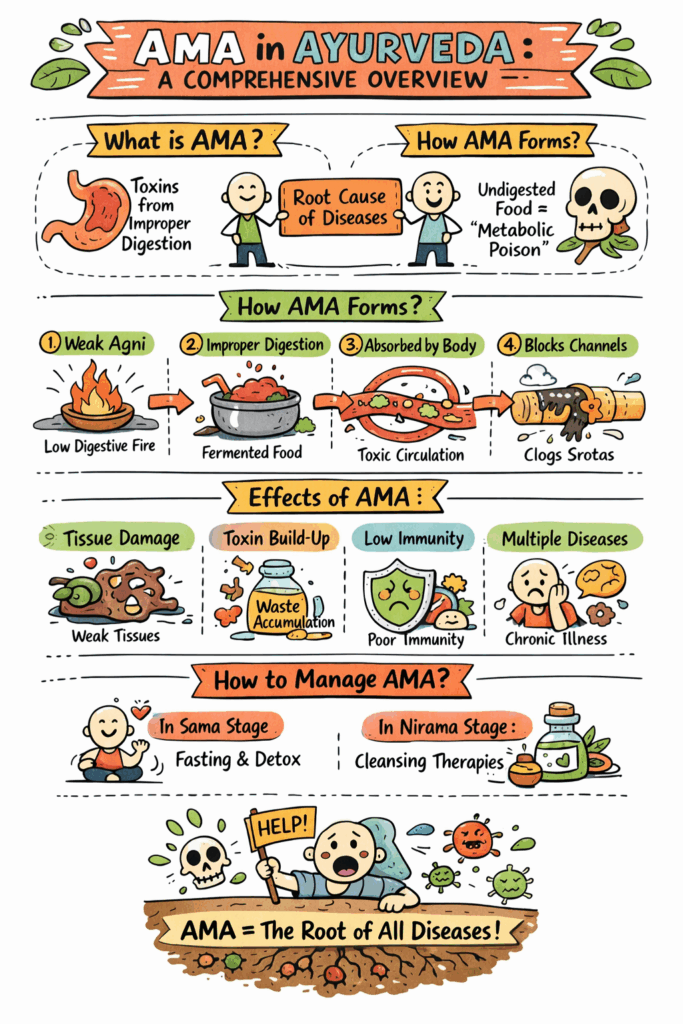
Formation of Ama
The root cause of Ama is impaired digestive fire (Agnimandya).
When digestion is inefficient:
Food is not properly metabolized
Immature nutritive material is formed
Retained food undergoes fermentation and putrefaction
Toxic intermediate products are generated
Different viewpoints describe Ama as:
Improperly formed nutritive fluid
Accumulated metabolic waste
Initial stage of Dosha vitiation
Ama thus represents defective metabolic processing and is considered the origin of disease.
Role of Rasa Agni
At the tissue level, weak Rasagni leads to improper formation of Rasa Dhatu. This poorly processed nutritive fluid is also termed Ama.
Characteristic Features of Ama
Ama exhibits the following properties:
Incompletely digested (Avipakwa)
Unassimilated (Asamyukta)
Foul smelling (Durgandha)
Sticky (Picchila)
Causes generalized weakness (Sadanam)
Causative Factors (Nidana)
Dietary Causes
Heavy, cold, dry, incompatible foods
Contaminated or untimely meals
Overeating and improper diet combinations
Psychological Factors
Anger, fear, grief, jealousy, stress
Emotional disturbances impair digestion
Lifestyle Factors
Night awakening
Day sleep
Suppression of natural urges
Even proper food may not digest in presence of mental stress.
Events in Ama Formation
Weak digestive fire
Improper digestion
Formation of immature nutritive material
Absorption into circulation
Obstruction of channels (Srotorodha)
Impaired tissue nourishment
Accumulation of wastes
Tissue damage
Disease manifestation
Sama Dosha, Dhatu, and Mala
When Ama combines with:
Doshas → Saama Dosha
Dhatus → Saama Dhatu
Malas → Saama Mala
These states are highly pathological and disease-producing.
CLINICAL FEATURES, CLASSICAL VIEWS & AMAVISHA
Kapha Dosha and Ama
Ama primarily affects Amashaya, the site of Kapha. This leads to abnormal Kapha formation and symptoms such as:
Heaviness
Loss of strength
Lethargy
Loss of appetite
Excess salivation
Constipation
Fatigue
Ama Pachana Therapy
Common formulations include:
Pachana Kashaya
Amritadi Kashaya
Expanded Classical Definitions
Classical texts describe Ama as:
Improperly digested Rasa
Toxic metabolic by-product
Early stage of disease
Product of Agni dysfunction
It is repeatedly emphasized that improperly digested food behaves like poison.
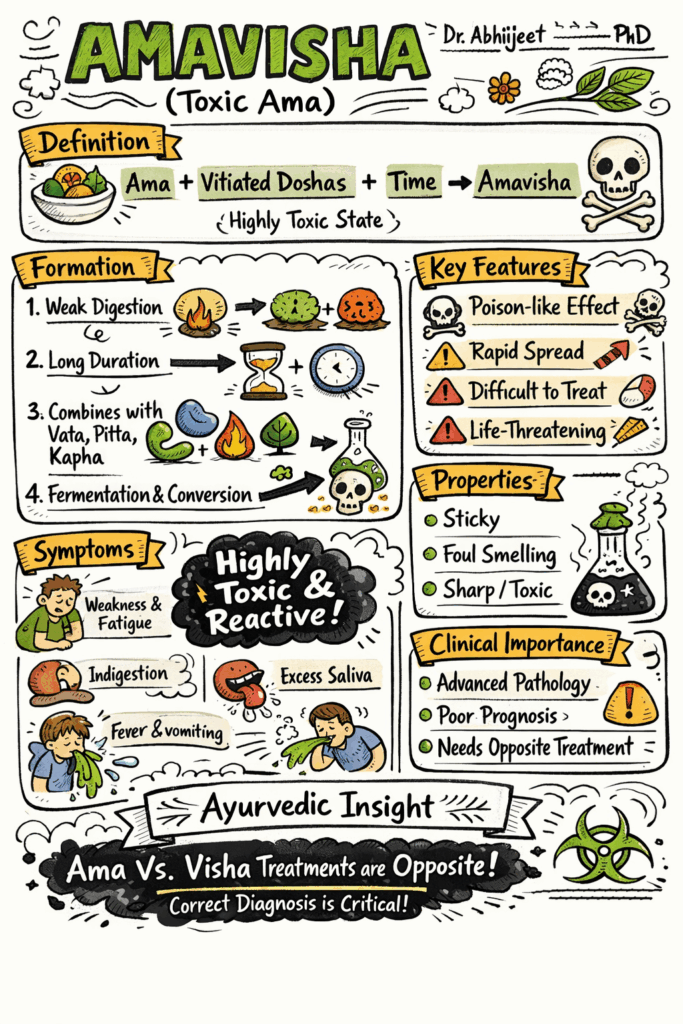
Ama Visha Concept
Ama, when highly toxic, is termed Ama Visha.
It resembles poisoning and may produce severe systemic manifestations.
It is formed when:
Digestion is severely impaired
Food undergoes fermentation
Toxic metabolites accumulate
Such a condition can be life-threatening.
Additional Interpretations
Ama is also described as:
Immature tissue state
Unprocessed substances
Early stage of inflammatory conditions
Pathological metabolic intermediate
PROPERTIES, SAMPRAPTI & MODERN CORRELATION
Properties of Ama
Ama possesses:
-
Indigestibility
-
Non-assimilability
-
Stickiness and heaviness
-
Foul smell
-
Tendency to obstruct channels
-
Ability to spread rapidly
-
Association with pain and dysfunction
It behaves similarly to toxins and is considered the root cause of diseases.
Pathogenesis (Samprapti)
-
Agni dysfunction
-
Formation of Ama
-
Association with Dosha/Dhatu/Mala
-
Circulation through channels
-
Lodgment at weak sites (Khavaigunya)
-
Disease manifestation
Disease Formation Sequence
Agnimandya → Ama → Dosha involvement → Srotorodha → Tissue damage → Disease
Modern Correlation
Ama can be correlated with:
-
Metabolic toxins
-
Endotoxins
-
Free radicals
-
Uric acid
-
Ketone bodies
-
Putrefactive substances
Free Radical Theory Correlation
Ama resembles free radicals in:
-
Incomplete metabolic state
-
Instability
-
Tissue damage potential
-
Rapid spread
-
Interaction with healthy cells
Both represent pathological biochemical states.
Importance of Ama in Treatment
Assessment of Ama is essential before treatment.
Treatment Principles
-
Sama stage → Langhana & Pachana
-
Nirama stage → Shodhana / Shamana
Incorrect treatment without Ama assessment may worsen disease.
FINAL CONCLUSION
Ama represents a central pathological concept in Ayurveda, describing toxic, incompletely processed metabolic material resulting from impaired digestion.
It plays a crucial role in:
-
Disease initiation
-
Progression
-
Chronicity
Understanding Ama is essential for accurate diagnosis, effective treatment, and prevention of diseases.
👉 Ama is the root cause of most diseases (Sarva Roga Hetu).
Dr Abhijeet Shirkande MD, PhD
