
By Dr Abhijeet Shirkande, MD, PhD
Introduction
Ayurveda, the ancient system of medicine originating in India, emphasizes the importance of Agni (digestive and metabolic fire) in maintaining health and preventing disease. Among all physiological principles described in Ayurvedic texts, Agni occupies a central position because it governs digestion, metabolism, tissue formation, and the production of vitality within the body.
The term Agni literally means “fire.” In Ayurvedic physiology, Agni represents the biological power responsible for digestion, transformation, and metabolism. Just as external fire converts raw substances into useful forms, internal Agni transforms ingested food into nutrients that nourish the body.
The Ayurvedic understanding of the human body is based on the concept of Panchamahabhuta, the five fundamental elements that constitute both the universe and the human body. These elements are:
- Prithvi (Earth)
- Ap or Jala (Water)
- Teja or Agni (Fire)
- Vayu (Air)
- Akasha (Space)
The combination of these elements forms the three doshas, which regulate the physiological functions of the body:
- Vata – formed by air and space
- Pitta – formed primarily by fire and water
- Kapha – formed by earth and water
Among these, Pitta dosha represents the biological manifestation of Agni, governing digestion, metabolism, and biochemical transformations.
Thus, Agni is not merely a digestive factor but a comprehensive metabolic principle responsible for sustaining life.
Concept of Agni
In Ayurveda, Agni refers to the transformative energy responsible for digestion, absorption, assimilation, and metabolism of food and nutrients.
The proper functioning of Agni is essential for maintaining health because it enables the body to convert food into energy, tissues, and vital substances.
Classical Ayurvedic texts emphasize the importance of Agni in sustaining life. Charaka explains the central role of Agni with the following statement:
बलम् आरोग्यम् आयुः च प्राणाः च अग्नौ प्रतिष्ठिताः॥
(Charaka Sutra 27/32)
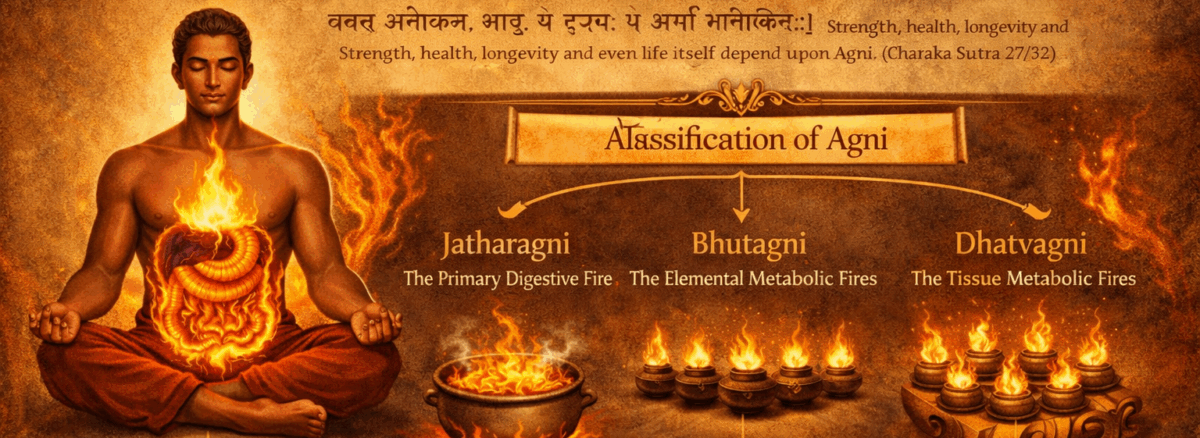
This statement indicates that strength, health, longevity, and even life itself depend upon Agni.
Agni operates at multiple levels in the body, including the gastrointestinal tract, tissues, and cellular structures. These levels of metabolic activity are described through the classification of different types of Agni.
Classification of Agni
According to classical Ayurvedic texts, there are thirteen types of Agni, which are broadly classified into three categories:
- Jatharagni – the primary digestive fire
- Bhutagni – the elemental metabolic fires
- Dhatvagni – the tissue metabolic fires
Each category represents a different stage of digestion and metabolism within the body.

Jatharagni: The Primary Digestive Fire
Jatharagni is the principal digestive fire located in the gastrointestinal tract. It is responsible for the initial digestion of food and plays a fundamental role in metabolism.
The term Jatharagni is derived from:
- Jathara – abdomen
- Agni – fire
Therefore, Jatharagni refers to the digestive fire present in the abdominal region responsible for breaking down food.
The functions of Jatharagni include:
- Digestion of ingested food
- Separation of nutritive and waste fractions
- Formation of primary nutritive fluid (Rasa Dhatu)
- Initiation of metabolic processes
Charaka emphasizes the central importance of Jatharagni:
अन्नस्य पक्ता सर्वेषां पक्तृणामधिपो मतः।
तत् मूलाः ते हि तत् वृद्धि क्षयात्मकाः॥
तस्मात् तं विधिवत् युक्तैः अन्न पान इन्धनैः हितः।
पालयेत् प्रयतः तस्य स्थितौ हि आयुः बल स्थितिः॥
(Charaka Chikitsa 15/39–40)
This verse explains that Jatharagni is the chief among all digestive processes, and maintaining its proper function is essential for longevity and strength.
Site of Jatharagni
The classical texts describe the location of Jatharagni in the Grahani region, which corresponds anatomically to the region between the stomach and intestines.
The classical description states:
स्व स्थानं कायाग्नेः पक्व आमाशययोः मध्यम्।
This means that the digestive fire is situated between the Amashaya (stomach) and Pakvashaya (large intestine).
The Grahani region plays a crucial role in digestion and nutrient absorption.
Bhutagni: Elemental Metabolic Fire
The second type of Agni described in Ayurveda is Bhutagni, which represents the metabolic transformation of the five elements present in food.
Since food contains all five elements, specific metabolic processes are required to convert these elements into forms suitable for the body.
There are five Bhutagnis, corresponding to the five elements:
- Parthiva Agni – earth element metabolism
- Apya Agni – water element metabolism
- Agneya Agni – fire element metabolism
- Vayavya Agni – air element metabolism
- Akashiya Agni – ether element metabolism
Charaka explains this process in the following verse:
भौम आप्य आग्नेय वायव्याः पञ्च ऊष्मणः स नाभसाः।
पञ्च आहार गुणान् स्वान् स्वान् पार्थिवादीन् पचन्ति हि॥
(Charaka Chikitsa 15/13)
This verse describes how the five elemental fires digest the respective elemental components of food.
Dhatvagni: Tissue Metabolic Fire
The third category of Agni is Dhatvagni, which functions at the level of body tissues.
Ayurveda describes seven Dhatvagnis, each associated with one of the seven tissues (Sapta Dhatus):
- Rasa Dhatvagni
- Rakta Dhatvagni
- Mamsa Dhatvagni
- Meda Dhatvagni
- Asthi Dhatvagni
- Majja Dhatvagni
- Shukra Dhatvagni
These metabolic fires transform nutrients into tissue components and also produce waste products.
Charaka explains this transformation as follows:
सप्तभिः देह धातरो धातवो द्विविध पुनः।
यथास्वं अग्निभिः पाकं यान्ति किट्ट प्रसादवत्॥
(Charaka Chikitsa 15/15)
This means that each tissue undergoes metabolic processing through its own Agni and produces nutritive essence (Prasada) and waste products (Kitta).
Antaragni (Internal Metabolic Fire)
Antaragni represents the internal metabolic force responsible for digestion and transformation within the body.
Acharya Sushruta explains the relationship between Agni and Pitta in the following statement:
न खलु पित्त व्यतिरेकात् अन्यो अग्निः उपलभ्यते।
(Sushruta Sutra 21/9)
This means that Agni cannot exist independently of Pitta, as Pitta represents the functional aspect of metabolic fire.
Functional States of Agni
Ayurveda recognizes four functional states of digestive fire depending on dosha influence.
The classical reference from Ashtanga Hridaya states:
तैर्भवेद्विषमस्तीक्ष्णो मन्दश्चाग्निः समैः समः॥
These four states include:
Sama Agni
Balanced digestive fire resulting in proper digestion and metabolism.
Vishama Agni
Irregular digestion caused by Vata imbalance.
Tikshna Agni
Excessively strong digestion caused by aggravated Pitta.
Manda Agni
Weak digestive fire associated with Kapha dominance.
Among these states, Sama Agni represents the ideal physiological condition.
Agni and Tissue Nourishment
According to Ayurveda, nourishment of body tissues occurs through a sequential process known as Dhatu Parinama.
Food is first digested by Jatharagni, producing Rasa Dhatu, the primary nutritive fluid. This fluid nourishes the subsequent tissues in the following sequence:
- Rasa
- Rakta
- Mamsa
- Meda
- Asthi
- Majja
- Shukra
This sequential nourishment ensures the maintenance of structural and functional integrity of the body.
Agni and Disease
Ayurveda strongly emphasizes that impaired digestion leads to disease.
A classical statement from Ashtanga Hridaya explains this relationship:
रोगाः सर्वे अपि मन्दे अग्नौ।
(Ashtanga Hridaya Nidana 12/1)
This means that all diseases arise when digestive fire becomes weak.
When Agni is impaired, food remains partially digested and produces Ama, a toxic metabolic by-product.
Ama possesses characteristics such as:
- heaviness
- stickiness
- foul odor
- obstruction of physiological channels
Accumulation of Ama disrupts normal physiological processes and leads to disease.
Causes of Agnimandya (Weak Digestive Fire)
Several factors can impair the functioning of Agni.
Important causes include:
- overeating
- irregular eating habits
- consumption of incompatible foods
- excessive intake of heavy foods
- sedentary lifestyle
- suppression of natural urges
- mental stress
- grief, fear, or anger
These factors disturb dosha balance and weaken digestive capacity.
Signs of Healthy Agni
Healthy Agni is characterized by several positive physiological indicators:
- timely and proper hunger
- efficient digestion
- absence of bloating or heaviness
- proper elimination of waste
- good energy levels
- healthy complexion
- stable body weight
These signs indicate optimal metabolic function.
Methods to Maintain Healthy Agni
Ayurveda recommends several measures to maintain balanced digestive fire.
Dietary Measures
- Eating freshly prepared food
- Consuming warm meals
- Maintaining regular meal timings
- Avoiding overeating
Lifestyle Practices
- Regular physical activity
- Adequate sleep
- Stress management
- Seasonal lifestyle adjustments
Herbal Support
Certain herbs help improve digestive fire.
Common examples include:
- Ginger
- Black pepper
- Long pepper
- Cumin
- Ajwain
These herbs stimulate digestion and prevent formation of Ama.
Clinical Importance of Agni
Assessment of Agni is essential in Ayurvedic diagnosis and treatment.
Understanding the status of Agni helps physicians determine:
- digestive capacity
- presence of Ama
- metabolic imbalance
- dosha disturbance
Many Ayurvedic treatments focus on strengthening Agni because restoration of digestive fire often leads to recovery from disease.
Conclusion
Agni represents the central metabolic principle in Ayurveda, governing digestion, metabolism, tissue formation, and immunity. The balance of Agni ensures proper nourishment of the body and maintenance of physiological harmony.
Impairment of Agni leads to incomplete digestion, toxin formation, and development of disease. Therefore, Ayurveda places great emphasis on protecting and maintaining digestive fire through proper diet, lifestyle practices, and herbal medicines.
Understanding the concept of Agni provides deep insight into Ayurvedic physiology and highlights the importance of digestion as the foundation of health.
Maintaining balanced Agni ultimately supports longevity, vitality, and holistic well-being.
