
Introduction
In Ayurvedic physiology, the human body is maintained by the harmonious balance of Dosha, Dhatu, and Mala. These three are considered the fundamental components responsible for maintaining the structure, function, and purification of the body. While Dhatus (tissues) build and nourish the body, Malas (waste products) are formed during digestion and metabolic activities and must be properly eliminated.
According to Ayurveda, waste matters are as important as body tissues in maintaining health and longevity. Even though they are waste products, their proper formation and elimination play a vital role in preserving physiological balance.
The human body is composed of thirteen major components, which include:
- Three Doshas
- Seven Dhatus
- Three Malas
These components together support the body’s structure and functions.
Tridoshas – Functional Components of the Body
The Tridoshas are the functional energies that regulate physiological processes in the body. They are:
- Vata
- Pitta
- Kapha
These Doshas govern all biological activities in the body. Although they are described as potential contaminants of the body when vitiated, in their balanced state they maintain normal physiological functions. When these Doshas become aggravated or imbalanced, they lead to various diseases.
Sapta Dhatus – Structural Components of the Body
The seven Dhatus represent the structural tissues that form the body. These tissues maintain strength, growth, and immunity.
The seven Dhatus are:
- Rasa – lymph and plasma
- Rakta – blood
- Mamsa – muscles
- Meda – fat or adipose tissue
- Asthi – bones
- Majja – bone marrow
- Shukra – reproductive tissue
These tissues form the structural framework of the body. Their proper nourishment and balance indicate good health and strong immunity. When the Dhatus become weak, they become susceptible to damage by vitiated Doshas, which may lead to disease.
Tri-Malas – The Three Major Waste Matters
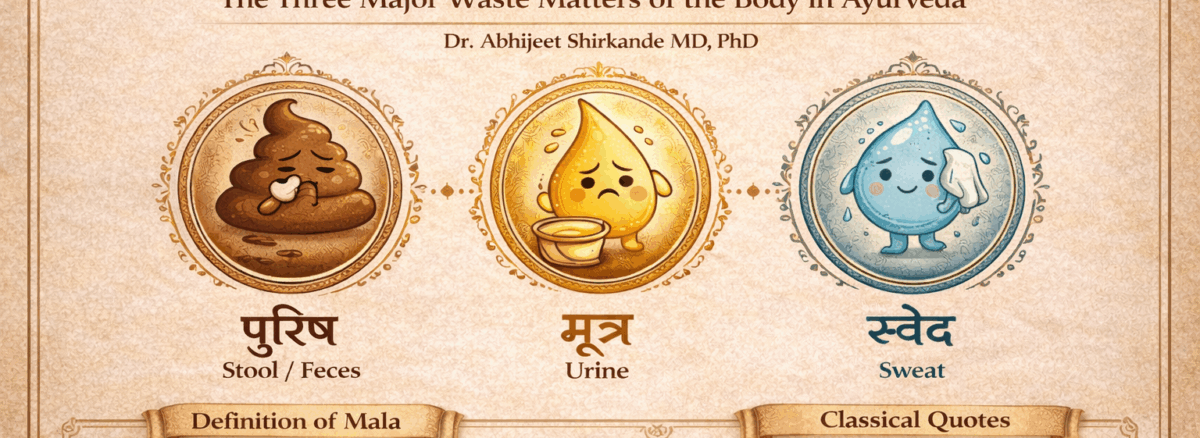
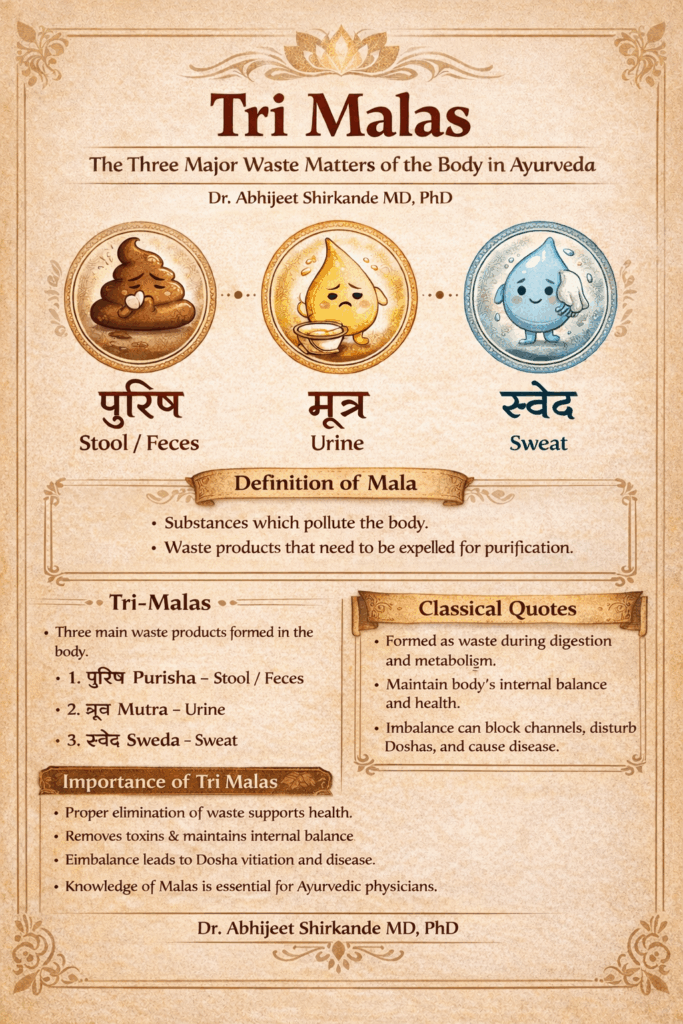
Ayurveda describes three major waste products of the body known as Tri-Malas. These wastes are produced daily as a result of digestion and metabolism.
The three Malas are:
- Purisha (stool)
- Mutra (urine)
- Sweda (sweat)
These wastes are produced continuously and must be eliminated from the body in the proper quantity and at the appropriate time. Their timely elimination helps maintain bodily health and physiological balance. If they accumulate in the body, they may cause various diseases.
Definition and Meaning of Mala
The term Mala refers to substances that are produced as waste during digestion and metabolism.
Malas are defined as:
- Substances that pollute other components of the body because they are waste products of food metabolism.
- Substances that purify the body when expelled from the body.
Thus, Malas are considered waste products, but their elimination helps cleanse the body and maintain health.
Mala
मलिनीकरणात् आहार मलत्वात् मलाः |
मृज्यते शोध्यते अनेन इति मलाः।
पक्व आमाशय मध्यस्थ पित्तं चतुर्विधम् अन्नपानं पचति, विवेचयति, च दोष रस मूत्र पुरीषाणि ॥ सु. सु. २१/१०
पक्व आमाशय मध्यस्थ पित्तं चतुर्विधम्
अन्नपानं पचति, विवेचयति, च दोष रस मूत्र पुरीषाणि ॥ सु. सु. २१/१०
पञ्चमी पुरीषधरा नाम, या अन्तः कोष्ठे मलम् अभिविभज्यते पक्वाशयस्था॥
उण्डुकस्थ विभजते मलं मलधरा कला॥ सु. शा.४/१६/१७
विण्मूत्रम् आहार मलः॥ सु.सू. ४६/५२
किट्टम् अन्नस्य विण्मूत्रं. || च. चि.१२/१८
तत्र आहार प्रसादाख्यो रसः कीट्ट च मलाख्यम् अभिनिर्वर्तते।
किट्टात् स्वेद मूत्र पुरीषः…………………….. पुष्यन्ति ॥ च. सू. २०
आहारस्य रसः सारः सारहीनो मलद्रव :। शा .पूर्व ६/६
Importance of Tri-Malas
Even though Malas are waste materials, they play an important role in maintaining health.
1. Proper elimination supports health
For the body to remain healthy, waste products must be eliminated in the correct quantity and at the appropriate time. If they remain inside the body, they disturb physiological functions and lead to disease.
Malas can be compared to disturbing elements in a system. When they are expelled properly, the body remains balanced and healthy.
2. They influence mental and sensory well-being
Retention of stool or urine can disturb not only the body but also the mind and senses. For example, conditions like constipation or urinary obstruction can cause physical discomfort along with mental irritation and restlessness.
3. Accumulation of Malas causes diseases
When the excreta accumulate in the body or are eliminated in insufficient quantity, they become vitiated and disturb the Doshas.
This disturbance particularly aggravates Vata, causing abnormal movement of Vata in undesired directions. This leads to disturbances in:
- digestion
- circulation
- respiration
- metabolism
The imbalance may gradually affect organs of the abdomen, chest, brain, and sensory organs.
4. Blockage of body channels
When waste products accumulate in the body, they exert pressure on various channels and ducts. This may block the normal flow of substances within the body.
As a result:
- circulation becomes impaired
- respiration may be affected
- toxins accumulate
- tissue nourishment becomes inadequate
This may ultimately lead to many diseases.
5. Malas contribute to strength and endurance
In certain diseases such as Rajayakshma (tuberculosis or wasting disorders), Malas are considered important for maintaining body strength.
In such conditions, Ayurveda advises physicians to avoid strong purgative therapies, because excessive elimination of Malas may weaken the patient further. In these conditions, feces may provide some level of strength to the body.
A classical statement explains this concept:
“Shukrayattam balam pumsaam, malayattam tu jeevitam”
Meaning:
- Strength depends on the balance of Shukra
- Life depends on the balance of Malas
6. Malas can also become contaminated
Dhatus and Malas together are referred to as Dushyas, meaning substances that can become contaminated by Doshas.
When Doshas contaminate Malas, they may produce diseases known as Mala Pradoshaja Rogas.
7. Diseases related to Mala channels
Each Mala has specific channels responsible for its formation and elimination.
These channels are called Malavaha Srotas.
- Purishavaha Srotas – channels responsible for feces
- Mutravaha Srotas – channels responsible for urine
- Swedavaha Srotas – channels responsible for sweat
Blockage or contamination of these channels may lead to diseases such as:
- constipation
- diarrhea
- dysentery
- diabetes
- painful urination
- abnormal sweating
- skin disorders
8. Abnormal increase or decrease of Malas
Malas should be maintained in normal quantity, quality, and consistency.
When the quantity of stool, urine, or sweat becomes excessive or insufficient, it may lead to various diseases.
Other Significant Points about Malas
Several important concepts related to Malas are described in Ayurvedic literature.
- Malas, along with Doshas and Dhatus, are considered the roots (Mula) of the body.
- Proper elimination of waste products (Sama Mala Kriya) is considered one of the important signs of good health.
- Doshas and Dhatus themselves may sometimes be referred to as Malas when they contaminate the body.
- Pitta located between the stomach and colon separates food into useful and waste components.
- The Maladhara Kala, located in the colon, helps in the formation and classification of excreta.
- Stool and urine are considered Ahara Mala, meaning waste derived from food after digestion.
- Sweat is also considered a waste product formed during fat metabolism (Meda Dhatu metabolism).
- The useful part of food after digestion is called Ahara Sara, while the waste portion is called Kitta or Mala.
Dhatu Malas (Minor Waste Products)
Apart from the major Malas, small quantities of waste are produced during tissue metabolism. These are called Dhatu Malas or Sukshma Malas.
These minor wastes are associated with specific tissues and represent metabolic by-products of those tissues.
Suppression of Natural Urges
Ayurveda strongly advises against suppressing the natural urges of defecation and urination.
Suppression of these urges may cause disorders such as:
- Pureesha Vega Avarodha Janya Rogas – diseases caused by suppression of defecation
- Mutra Vega Avarodha Janya Rogas – diseases caused by suppression of urination
Such suppression may also lead to Udavarta, a condition caused by abnormal movement of Vata.
Importance of Knowledge of Malas for Physicians
Knowledge of Malas is essential for physicians because:
- The quality and quantity of Malas help determine whether they are balanced or abnormal.
- Understanding diseases caused by contamination of Malas helps in diagnosing pathology correctly.
- It assists physicians in selecting appropriate treatments to eliminate accumulated waste.
- It also helps physicians know when to conserve Malas, especially in conditions where excessive loss weakens the patient.
- This knowledge helps preserve patient strength and life in conditions like Rajayakshma.
Conclusion
The concept of Tri-Malas highlights the importance of waste elimination in Ayurvedic physiology. Although Malas are waste products, they play a crucial role in maintaining physiological balance.
Proper formation and elimination of stool, urine, and sweat help maintain internal purity, support bodily functions, and prevent disease. Ayurveda therefore emphasizes that maintaining the balance of Dosha, Dhatu, and Mala is essential for achieving health and longevity.
