
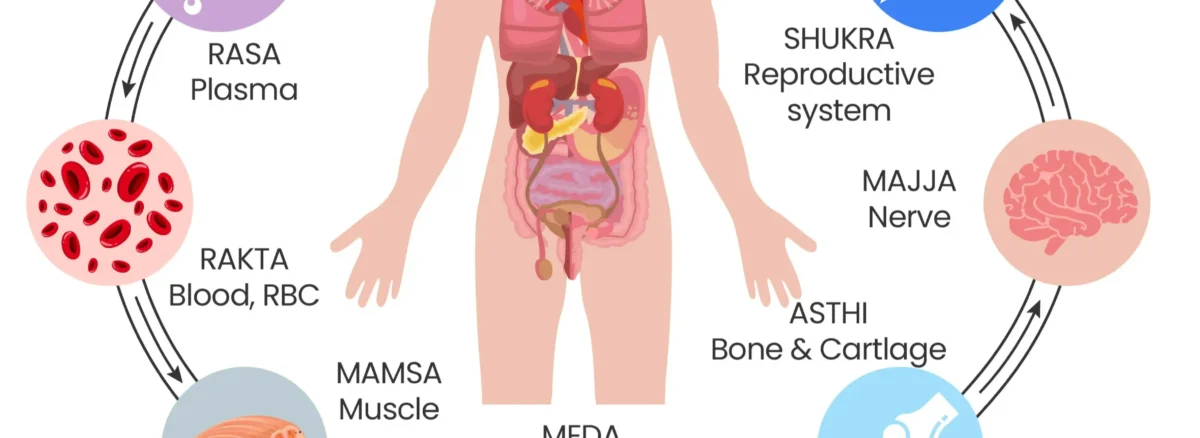
Meaning and Concept of Dhatu
The word Dhatu originates from the Sanskrit root “Dhru”, which means to support, sustain, or maintain. Therefore, Dhatus are the tissues that support the body both structurally and functionally.
Food consumed by the body is digested by Jatharagni (digestive fire) to form Ahara Rasa (nutritive essence). This essence circulates in the body and nourishes the tissues sequentially through the process known as Dhatu Parinama (tissue transformation).
Each Dhatu has:
-
- Specific functions
-
- Specific location
-
- Dhatu Agni (metabolic activity)
-
- Upadhatu (secondary tissue)
-
- Mala (waste product)
The Seven Dhatus (Sapta Dhatu)
1. Rasa Dhatu
Rasa Dhatu is the first tissue formed after digestion of food. It represents the circulating nutritive fluid in the body.
Modern correlation
Plasma, lymph, and interstitial fluid.
Main functions
-
- Nourishes all other tissues
-
- Maintains hydration and fluid balance
-
- Supports circulation of nutrients
-
- Maintains enthusiasm and emotional stability
Main location
-
- Hridaya (heart)
-
- Rasa Vaha Srotas (circulatory channels)
Upadhatu
-
- Stanya (breast milk)
-
- Raja (menstrual blood)
Mala
-
- Kapha (some texts describe mucous secretions)
2. Rakta Dhatu
Rakta Dhatu corresponds to blood tissue, which is essential for sustaining life and maintaining vitality.
Modern correlation
Blood and its cellular components.
Functions
-
- Carries oxygen and nutrients
-
- Maintains skin complexion
-
- Supports metabolic activities
-
- Provides vitality and life energy
Main location
-
- Yakrit (liver)
-
- Pleeha (spleen)
Upadhatu
-
- Sira (blood vessels)
-
- Kandara (tendons)
Mala
-
- Pitta
3. Mamsa Dhatu
Mamsa Dhatu represents muscle tissue, which forms the bulk of the body and provides structural support.
Modern correlation
Skeletal muscles and muscular system.
Functions
-
- Gives shape and form to the body
-
- Protects internal organs
-
- Enables physical movement
-
- Maintains strength and stability
Main location
Muscles distributed throughout the body.
Upadhatu
-
- Tvak (skin)
Mala
-
- Secretions from ears, nose, eyes, etc.
4. Meda Dhatu
Meda Dhatu refers to fat tissue or adipose tissue.
Modern correlation
Adipose tissue and lipid storage.
Functions
-
- Lubricates body tissues
-
- Stores energy
-
- Maintains insulation
-
- Supports flexibility and softness of body
Main location
-
- Sphik (buttocks)
-
- Udara (abdomen)
-
- Stana (breasts)
Upadhatu
-
- Snayu (ligaments)
Mala
-
- Sweda (sweat)
5. Asthi Dhatu
Asthi Dhatu represents the skeletal system.
Modern correlation
Bones and skeletal structure.
Functions
-
- Provides structural support
-
- Protects vital organs
-
- Maintains posture
-
- Supports movement
Main location
-
- Bones
-
- Teeth
-
- Nails
Upadhatu
-
- Danta (teeth)
Mala
-
- Hair and nails (in some classical descriptions)
6. Majja Dhatu
Majja Dhatu represents the bone marrow and fatty tissues within bones.
Modern correlation
Bone marrow and nervous tissue.
Functions
-
- Fills bone cavities
-
- Strengthens bones
-
- Supports nervous system
-
- Nourishes Asthi Dhatu
Main location
Bone marrow inside bones
Upadhatu
Not clearly described in some texts.
Mala
-
- Oily secretions of eyes and skin.
7. Shukra Dhatu
Shukra Dhatu is the final tissue in the Dhatu sequence and represents the reproductive tissue.
Modern correlation
Male and female reproductive cells.
Functions
-
- Reproduction
-
- Vitality and strength
-
- Tissue regeneration
-
- Mental stability and enthusiasm
Main location
Reproductive organs.
Upadhatu
-
- Ojas (in a broader sense related to vitality)
Mala
No significant waste product mentioned.
Dhatu Transformation (Dhatu Parinama)
The nourishment of tissues occurs in a sequential manner:
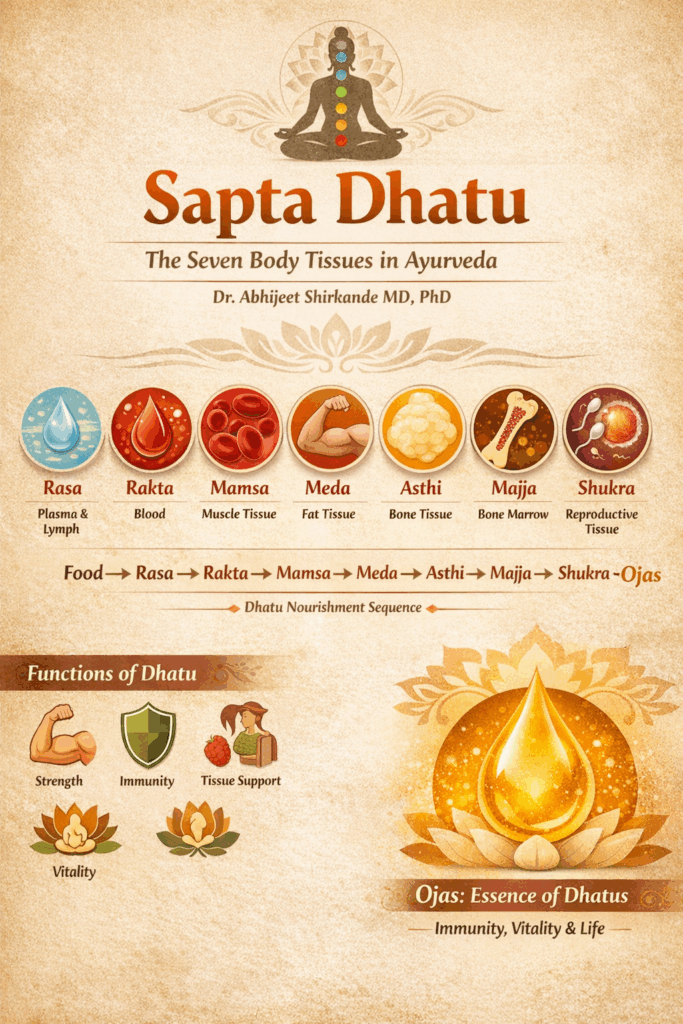
Food → Rasa → Rakta → Mamsa → Meda → Asthi → Majja → Shukra
Each Dhatu extracts nutrients from the previous tissue through Dhatu Agni and converts them into its own tissue substance.
This process ensures continuous tissue nourishment and regeneration.
Importance of Balanced Dhatus
Balanced Dhatus maintain:
-
- Proper growth and development
-
- Strength and endurance
-
- Immunity
-
- Tissue repair
-
- Mental stability
Imbalance may lead to conditions such as:
-
- Tissue depletion (Dhatu Kshaya)
-
- Tissue excess (Dhatu Vriddhi)
-
- Functional disturbances in organs
Ojas – The Essence of Dhatus
When all seven Dhatus are healthy and properly nourished, the body produces Ojas, the finest essence responsible for:
-
- Immunity
-
- Vitality
-
- Strength
-
- Longevity
Ojas is considered the foundation of life and health in Ayurveda.
Conclusion
The concept of Sapta Dhatu explains how the human body is formed, nourished, and maintained according to Ayurvedic principles. Proper digestion, balanced diet, and a healthy lifestyle are essential for maintaining the health of these tissues.
By understanding the Dhatus, Ayurveda provides a holistic approach to health, emphasizing prevention, balance, and long-term well-being.
Dr Abhijeet Shirkande MD, PhD
Shirkande Ayurved Clinic
