
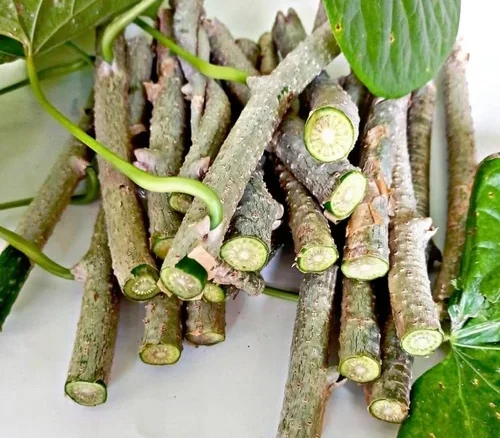
Guduchi, popularly known as Giloy, is one of the most revered medicinal plants in Ayurveda. It is often called “Amrita”, meaning nectar of immortality, because of its remarkable ability to enhance immunity, restore balance in the body, and promote longevity. For centuries, Guduchi has been used extensively in the management of fever, metabolic disorders, liver diseases, skin conditions, autoimmune disorders, and chronic inflammatory states.
In the modern era, Guduchi has gained renewed attention due to its immunomodulatory, antipyretic, antioxidant, anti-inflammatory, and rejuvenative properties, making it highly relevant in both preventive and therapeutic healthcare.
- Kingdom: Plantae
- Subkingdom: Phanerogamia
- Division: Angiosperm
- Class: Dicotyledons
- Subclass: Thalamiflorae
- Family: Menispermaceae
- Genus: Tinospora
- Species: cordifolia
Botanical Identity and Classical Background
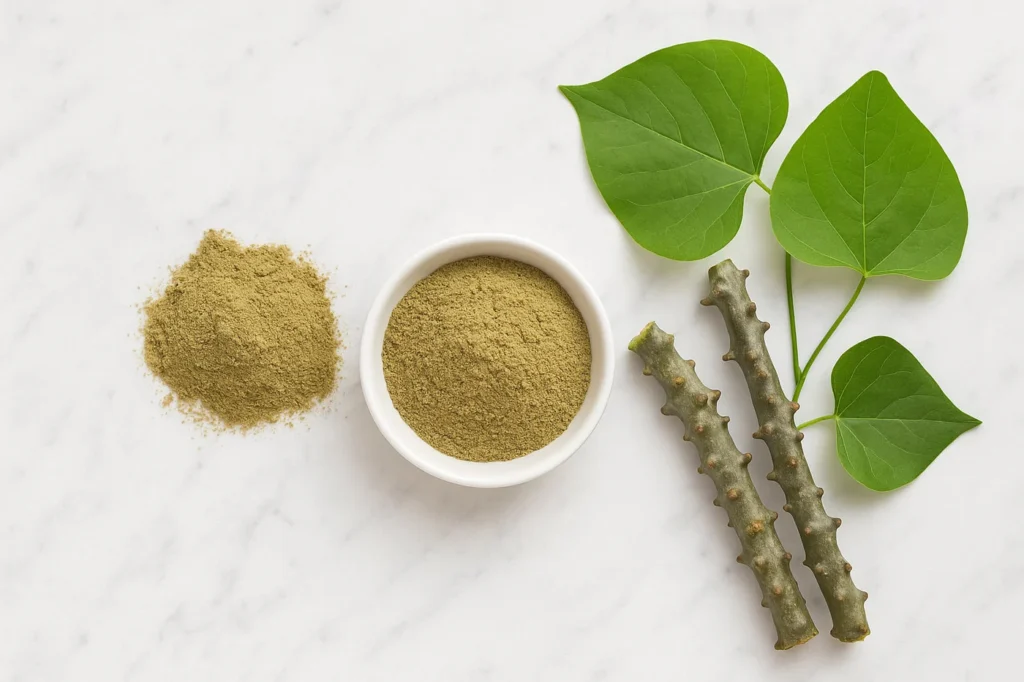
Guduchi’s botanical name is Tinospora cordifolia (Willd.) ex Ser., belonging to the Menispermaceae family. In classical Ayurvedic texts, Guduchi is praised for its ability to support life force (Ojas), correct metabolic imbalance (Agni), and eliminate toxins (Ama).
Charaka, Sushruta, and Vagbhata have all described Guduchi as a Rasayana dravya, emphasizing its role in strengthening immunity, intellect, digestion, and overall vitality.
Ayurvedic Properties of Guduchi
From an Ayurvedic perspective, Guduchi possesses a unique combination of qualities that allow it to balance all three Doshas.
- Rasa (Taste): Tikta (bitter) and Kashaya (astringent)
- Guna (Qualities): Laghu (light), Snigdha (unctuous)
- Virya (Potency): Ushna (hot)
- Vipaka (Post-digestive effect): Madhura (sweet)
- Dosha Action: Tridoshahara (balances Vata, Pitta, and Kapha)
Although Guduchi is Ushna in potency, it does not aggravate Pitta. This is because its bitter taste and sweet post-digestive effect help pacify Pitta and relieve burning sensations. This rare balance makes Guduchi safe and effective for long-term use when prescribed appropriately.
Vernacular Names and Sanskrit Synonyms
Names in Various Languages
English: Indian Tinospora, Heart-leaved moonseed, Heart-leaved tinospora, Indian tinospora, Tinospora gulancha
Hindi: Giloy, Gurach, Gulvel, Guruch
Kannada: Amrballi, Amruthaballi
Malayalam: Amrithavalli, Chittamrith
Telugu: Dussiramu, Tippatige
Marathi: Ambarvel, Amruta, Amritavalli, Guduchi, Gulvel
Bengali: Giloy, Gulancha
Oriya: Gulochi, Gulancha
Punjabi: Batindu, Gilogularich
Gujarati: Gulo, Gado, Galo
Sikkim: Gurjo
Tamil: Amrida Valli, Siiam, Pattigai, Amritavalli, Kunali, Seendhil Kodi, Seenthil Kodi
Assamese: Hoguni-lot
Konkani: Amritvel
Manipuri: Ningthou Khongli
Mizo: Theisawntlung
Nepalese: Gurjo
Urdu: Gurch, Gluncha
Sanskrit Synonyms and Their Meanings
- Amruta / Amrita – Means “nectar.” Frequently used in formulations such as Amruttara Kashaya.
- Guduchi – Suggests protection of the body from disease.
- Chakralakshana – Refers to the wheel-like structure seen in the transverse stem section.
- Chandradhasa – Indicates the moon-like appearance when the stem is cut crosswise.
- Chinnaruha / Chinnodhbhava – Describes the plant’s ability to regrow even after repeated cutting.
- Jwarari / Jwaranashini – Effective in treating fever.
- Ayatha, Amravalli, Kundali, Guduchika, Jivanti, Tantrika, Devamrita, Dhara, Nagakanayaka, Bhishakpriya – Traditional synonyms.
- Madhuparni – Leaves produce a sticky juice resembling honey when crushed.
- Somavalli, Vayastha – Associated with promoting longevity.
Classical Categorization in Ayurveda
According to Charaka:
Guduchi is included in the following groups:
- Vayasthapana – Rejuvenating herbs
- Daha Prashamana – Herbs that reduce burning sensation
- Trishna Nigrahana – Herbs that relieve excessive thirst
- Triptighna – Herbs that alleviate early satiety
- Stanyashodhana – Herbs that purify breast milk
According to Sushruta:
Classified under:
- Guduchyadi
- Patoladi
- Valli Panchamoola
- Kakolyadi
- Aragvadhadi groups
According to Bhavaprakasha:
Grouped under Guduchyadi Varga (a set of four herbs).
References in Classical Texts
- Kaiyadeva Nighantu: Includes Guduchi in Aushadha Varga.
- Chaturbhadra Group: Ativisha, Shunthi, Musta, and Guduchi.
- Charaka Samhita: Lists Guduchi among the four Medhya Rasayana (brain tonics that enhance memory), recommending its juice extract.
- Bhavaprakasha Nighantu, Sodhala Nighantu, Nighantu Adarsha, Dhanvantari Nighantu: Place Guduchi under Guduchyadi Varga.
- Priya Nighantu: Categorized under Pippalyadi Varga.
Varieties and Classification of Giloy (Guduchi)
Known Varieties
- Tinospora crispa
- Tinospora malabarica
- Tinospora sinensis
- Tinospora tomentosa
Other Types (Dhanvantari Nighantu)
- Padmaguduchi
- Kanda Guduchi
Botanical Identification
The name Guduchi commonly refers to Tinospora cordifolia and Tinospora malabarica.
Morphological Description
- A large, smooth climbing plant with fleshy, corky, grooved stems.
- Leaves: Thin, rounded to somewhat triangular, heart-shaped with a broad sinus and prominent basal lobes. Petiole length ranges from 2.5 to 7 cm.
- Inflorescence: Loose, axillary, elongated, often longer than the leaves.
- Flowers: Found in clusters within the axils of small bracts; six sepals.
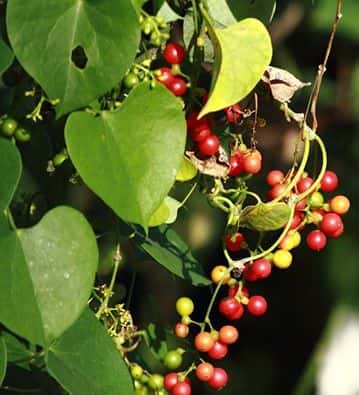
- Fruits: Turn red upon ripening, roughly the size of a large pea.
- Seeds: Broadly elliptical with a slight dorsal ridge and ventral depression.
Useful Part
- Stem
Manufacturer Example
Baidyanath Giloy Juice is produced by Shree Baidyanath Ayurved Bhawan Pvt. Ltd.
Preparation of Giloy Tablets
- Prepare a decoction (kashaya) by adding 100 grams of Giloy powder to 1 liter of water.
- Boil until the liquid reduces to approximately 250–300 ml.
- Strain the liquid.
- Add 150 grams of Giloy powder to the decoction.
- Heat gently until the mixture thickens to a semi-solid consistency.
- Roll the mass into pills.
Liver Damage
There are discussions regarding whether Guduchi may cause liver damage. The issue requires careful medical evaluation and professional guidance.
Tinospora crispa
Tinospora crispa is sometimes used as an adulterant or substitute for Guduchi. However, it does not provide the same therapeutic benefits as Tinospora cordifolia. Differences exist between these species.
Systemic Actions
Internal Administration
Digestive System
Acts as a carminative and digestive stimulant. Helps regulate doshas and supports bile secretion from the gallbladder. Indicated for vomiting, excessive thirst, poor appetite, liver disorders, acidity, acid reflux, jaundice, helminth infections, and abdominal colic.
Respiratory System
Balances Kapha dosha and is useful in cough.
Circulatory System
Functions as a cardiac tonic. Indicated in anemia, vatarakta, and amavata.
Reproductive System
Acts as an aphrodisiac and is recommended in conditions such as oligospermia.
Excretory System
Indicated in diabetes.
Skin (Tvak)
Used in various skin disorders and may also benefit syphilis.
Satmikaran
Considered rejuvenative.
Tapakrama
Indicated in fever, including associated burning sensations (Vishamajvara, Jirna Jvara).
How to Consume Guduchi
The best and most classical method of consuming Guduchi is in the form of Kashaya (decoction).
Guduchi decoction is prepared by boiling Guduchi powder in water and reducing it to half. This ensures maximum extraction of its active principles.
Guduchi is also available and commonly used in other forms such as:
- Guduchi powder (Churna)
- Guduchi Satva (aqueous extract)
- Guduchi capsules
- Guduchi Ghanavati (tablets)
Each form has its own therapeutic utility depending on the disease, strength of the patient, and digestive capacity.
Home Remedies Using Guduchi
Guduchi is highly versatile and can be combined with various Anupana (adjuvants) to target specific disorders.
When taken with ghee, Guduchi helps alleviate Vata disorders such as arthritis and joint stiffness. Combined with jaggery, it is useful in relieving constipation. When administered with sugar candy, Guduchi becomes effective in Pitta disorders such as gastritis, liver diseases, skin conditions, and dizziness.
In gout and inflammatory arthritis, Guduchi taken along with castor oil provides significant relief. For rheumatoid arthritis, Guduchi combined with dry ginger powder is beneficial.
Classical texts also mention Guduchi in severe Pitta conditions like vomiting with burning sensation, as described in Charaka Chikitsa Sthana (20/31).
Therapeutic Uses and Indications
Guduchi is extensively used in a wide range of clinical conditions. It is especially known for its role in fever management, where it is considered one of the most important herbs. In fact, nearly 90% of Ayurvedic formulations for fever contain Guduchi as a key ingredient.
Guduchi improves digestion and absorption, making it useful in malabsorption syndrome, chronic diarrhea, and digestive weakness. Its blood-purifying action makes it effective in skin diseases, anemia, and inflammatory disorders.
In metabolic conditions like diabetes and urinary tract disorders, Guduchi helps regulate blood sugar and improves urinary function. It is also beneficial in jaundice and other liver disorders due to its hepatoprotective properties.
Guduchi plays a valuable role in respiratory conditions such as cough, asthma, and bronchitis. It is useful in gout, rheumatoid arthritis, and autoimmune disorders due to its anti-inflammatory and immunomodulatory effects.
Additionally, Guduchi supports eye health, cardiac function in Vata-dominant conditions, and acts as an aphrodisiac and rejuvenator.
Part Used and Special Classical Insight
The stem of Guduchi is the most commonly used and pharmacologically active part. Leaves and aerial roots are also used but are comparatively less potent.
An interesting classical reference mentions that Sushruta used Guduchi aerial roots for suturing surgical wounds. These roots are extremely strong and possess wound-healing properties, reducing the risk of wound rupture and promoting faster healing.
Dosage and Duration
Guduchi dosage depends on the form used:
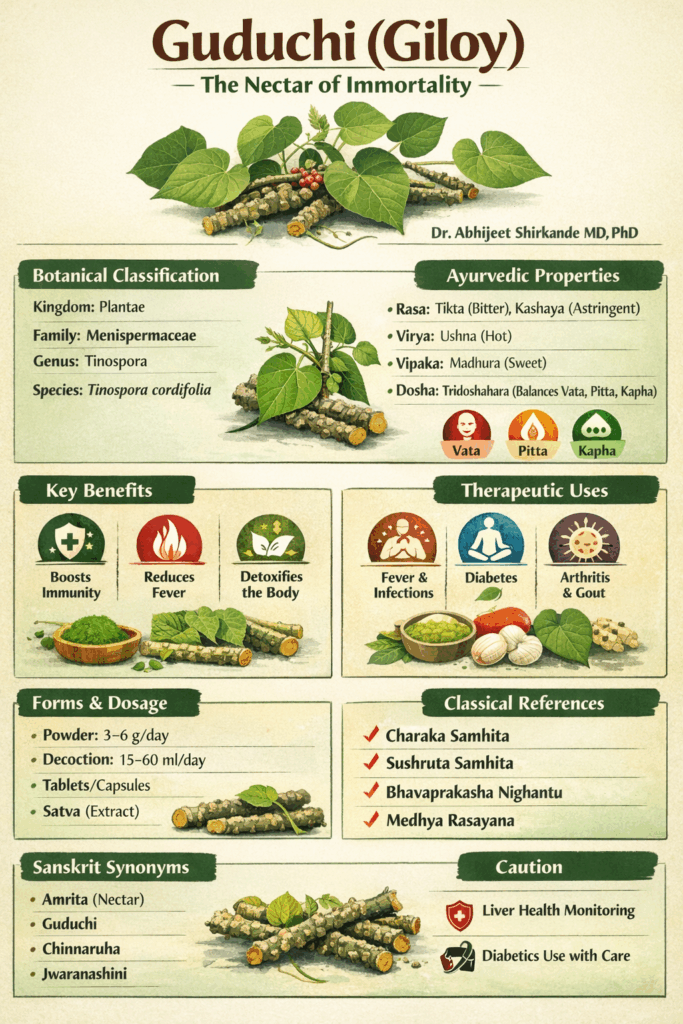
- Powder: 3–6 grams per day
- Decoction: 15–60 ml per day
- Guduchi Satva: as prescribed
- Rasayana dose: 5–10 grams twice daily after food
For children, lower doses are advised, usually administered with honey. Guduchi can be safely taken for 2–3 months, or longer under medical supervision.
Guduchi as an Immunity Booster and in Viral Fevers
Guduchi enhances immunity and helps regulate body temperature during fever. While it shows potential benefits in viral infections and immune support, claiming 100% prevention against viral diseases is not scientifically appropriate without clinical trials.
Guduchi may be used as a supportive therapy to strengthen immunity, reduce fever intensity, and aid recovery.
Side Effects and Precautions
Guduchi is generally safe when used correctly. However, due to its blood sugar–lowering effect, diabetic patients on medication should use it under medical supervision.
Its use during pregnancy should be strictly guided by an Ayurvedic physician. When taken along with modern medicines, a time gap of about 30 minutes is recommended.
Chemical Constituents and Pharmacological Actions
Guduchi contains a wide range of bioactive compounds including alkaloids, glycosides, steroids, diterpenoid lactones, and antioxidants. These compounds contribute to its antipyretic, anti-inflammatory, hepatoprotective, immunomodulatory, antiviral, and wound-healing properties.
Nutritional Value and Research Evidence
Guduchi is rich in essential minerals such as calcium, iron, zinc, copper, and manganese. Research studies have demonstrated its immunomodulatory effect, antipyretic activity, and potential role in chronic inflammatory and metabolic disorders.
Guduchi as a Rasayana and in PCOS
Classical texts describe Guduchi as a Medhya Rasayana, supporting brain function and longevity. Regular use improves vitality, intellect, and resistance to disease.
In women with PCOS, Guduchi helps improve insulin resistance, regulate blood sugar levels, and prevent excessive weight gain, making it a valuable supportive herb in integrative management.
Conclusion
Guduchi stands as one of Ayurveda’s most powerful and versatile medicinal plants. Its ability to balance all three Doshas, strengthen immunity, correct metabolism, and rejuvenate tissues makes it invaluable in both preventive and therapeutic healthcare. When used judiciously under proper guidance, Guduchi truly lives up to its name—Amrita, the nectar of life.
Dr Abhijeet Shirkande MD, PhD
Shirkande Ayurved Clinic
