
1️⃣ Botanical Identity
Commiphora mukul
Family: Burseraceae
Other botanical synonyms:
- Commiphora wightii
- Commiphora roxburghii
- Commiphora myrrha (sometimes used commercially)
Common English name: Indian Bdellium
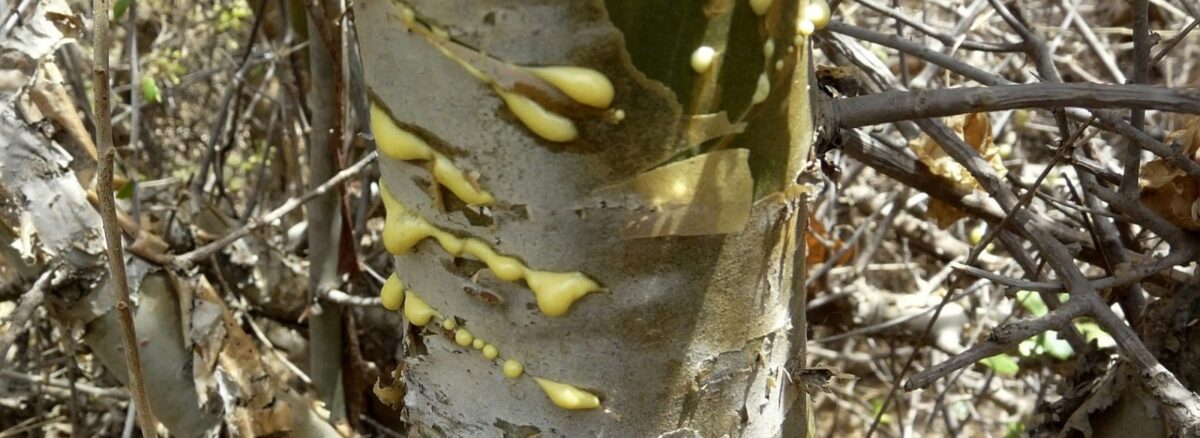
Guggulu is an oleo-gum resin obtained from the bark of this thorny shrub native to arid regions of India.
2️⃣ Synonyms & Classical Names
- Devadhupa (used in sacred fumigation)
- Mahishaksha (resembles buffalo eye color)
- Palankasha (reduces obesity)
- Kumbha, Ulukhala, Mahaneela
Guggulu has references in classical Ayurvedic texts such as Charaka Samhita and Sushruta Samhita, where it is praised for metabolic, inflammatory, and wound-healing actions.
गुग्गुलुर्देवधूपश्च जटायुः कौशिकः पुरः |
कुस्तालू खलकं क्लीबे महिषाक्षः पलङ्कषः ||२९||
महिषाक्षो महानीलः कुमुदः पद्म इत्यपि |
हिरण्यः पञ्चमो ज्ञेयो गुग्गुलोः पञ्च जातयः ||३०||
भृङ्गाञ्जनसवर्णस्तु महिषाक्ष इति स्मृतः |
महानीलस्तु विज्ञेयः स्वनामसमलक्षणः ||३१||
कुमुदः कुमदाह्वः स्यात्पद्मो माणिक्यसन्निभः |
हिरण्याक्षस्तु हेमाभः पञ्चानां लिङ्गमीरितम् ||३२||
महिषाक्षो महानीलो गजेन्द्राणां हितावुभौ |
हयानां कुमुदः पद्मः स्वस्त्यारोग्यकरौ परौ ||३३||
विशेषेण मनुष्याणां कनकः परिकीर्तितः |
कदाचिन्महिषाक्षश्च यतः कैश्चिन्नृणामपि ||३४||
गुग्गुलुर्विशदस्तिक्तो वीर्योष्णः पित्तलः सरः |
कषायः कटुकः पाके कटू रूक्षो लघुः परः ||३५||
भग्नसन्धानकृद्वृष्यः सूक्ष्मः स्वर्यो रसायनः |
दीपनः पिच्छिलो बल्यः कफवातव्रणापचीः ||३६||
मेदोमेहाश्मवातांश्च क्लेदकुष्ठाममारुतान् |
पिडकाग्रन्थिशोफार्शोगण्डमालाकृमीञ्जयेत् |
माधुर्याच्छमयेद्वातं कषायत्वाच्च पित्तहा ||३७||
तिक्तत्वाद् कफजित्तेन गुग्गुलुः सर्वदोषहा |
स नवो बृंहणो वृष्यः पुराणस्त्वतिलेखनः ||३८||
स्निग्धः काञ्चनसंकाशः पक्वजम्बूफलोपमः |
नूतनो गुग्गुलुः प्रोक्तः सुगन्धिर्यस्तु पिच्छिलः ||३९||
शुष्को दुर्गन्धकश्चैव त्यक्तप्रकृतिवर्णकः |
पुराणः स तु विज्ञेयो गुग्गुलुर्वीर्यवर्जितः ||४०||
अम्लं तीक्ष्णमजीर्णञ्च व्यवायं श्रममातपम् |
मद्यं रोषं त्यजेत्सम्यग् गुणार्थी पुरसेवकः ||४१|| भावप्रकाशनिघण्टु
3️⃣ Morphology
- Shrub reaching 4–6 feet
- Knotty, crooked branches with sharp spines
- Leaves: small, 1–2 foliate
- Flowers: small fascicles
- Fruit: drupe
- Seeds: ovoid, splitting into two
The resin exudes from bark incisions and solidifies upon drying.
4️⃣ Classical Categorisation & Varieties
Mentioned Varieties (Bhavaprakasha):
- Mahishaksha (black)
- Mahaneela (blue)
- Padma (red)
- Kumuda (brownish)
- Kanaka (yellow)
Commercial Grades:
- Grade 1: Translucent, pure resin
- Grade 2: Dull, mixed material
- Grade 3: Inferior quality
5️⃣ Pharmacodynamic Profile (Rasa Panchaka)
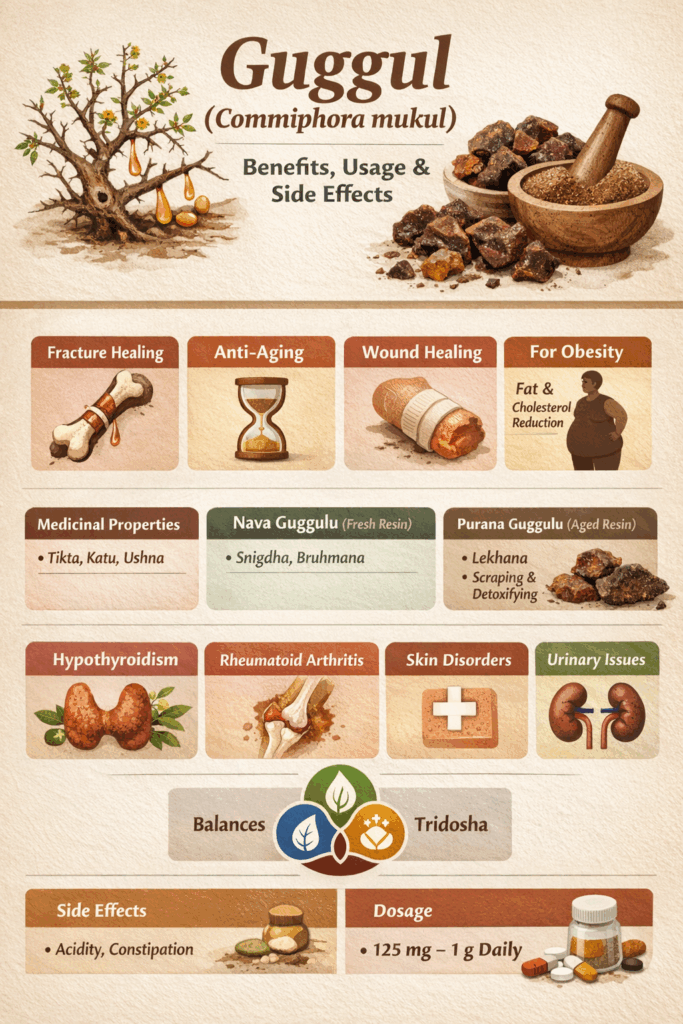
- Rasa: Tikta (bitter), Katu (pungent)
- Guna: Laghu (light), Ruksha (dry), Vishada (clarifying), Sukshma (subtle), Sara (mobilizing)
- Veerya: Ushna (hot potency)
- Vipaka: Katu
These properties explain its scraping (Lekhana), anti-inflammatory and metabolic-stimulating nature.
6️⃣ Nava vs Purana Guggulu
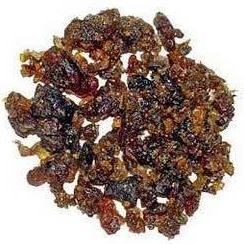
Fresh (Nava – <1 year):
- Snigdha (unctuous)
- Picchila (sticky)
- Bruhmana (nourishing)
- Vrushya (aphrodisiac)
Old (Purana – >1 year):
- Lekhana (scraping action)
- Channel-clearing
- Metabolic stimulant
- Balances Tridosha
Most commercial preparations use aged Guggulu, hence stronger fat-reducing action.
7️⃣ Sthanika Karma (Systemic Actions)
🦴 Musculoskeletal
- Anti-inflammatory
- Analgesic
- Bone healing enhancer
Used in formulations like Lakshadi Guggulu.
❤️ Cardiovascular
- Lipid lowering
- Improves circulation
- Supports heart health
🍽 Digestive
- Deepana (improves digestion)
- Carminative
- Anti-helminthic
🩺 Excretory
- Useful in renal calculi
- Promotes urine output
🧠 Nervous System
- Vatahara
- Relieves sciatica and gout
8️⃣ Guggulu in Obesity & Metabolic Disorders
Classical texts describe it as a prime herb for Medoroga (obesity).
Mechanism (Modern Understanding)
- Guggulsterones modulate lipid metabolism
- Reduces LDL and triglycerides
- Improves thyroid activity
- Enhances fat mobilization
It is widely used in:
- Triphala Guggulu
- Navaka Guggulu
- Kaishora Guggulu
- Kanchanara Guggulu
Useful in:
- Obesity with diabetes
- Joint pain due to excess weight
- Dyslipidemia
- Metabolic syndrome
9️⃣ Guggulu in Hypothyroidism
Certain Guggulu formulations support thyroid function by:
- Enhancing T3 conversion
- Reducing metabolic sluggishness
- Decreasing edema
Kanchanara Guggulu is widely used in thyroid enlargement and nodules.
🔟 Fracture Healing & Musculoskeletal Strength
Guggulu is described as Bhagnasandhanakrut (bone union promoter).
- Accelerates bone regeneration
- Reduces inflammation
- Improves joint mobility
This makes it useful in fractures, ligament injuries, and dislocations.
1️⃣1️⃣ Anti-Aging (Rasayana)
Despite its scraping action, Guggulu is considered Rasayana when used appropriately.
- Improves digestion
- Enhances tissue metabolism
- Supports immunity
- Maintains cardiovascular integrity
1️⃣2️⃣ Wound Healing
- Antimicrobial
- Reduces edema
- Promotes granulation tissue
- Used in abscess, fistula, chronic wounds
1️⃣3️⃣ Effect on Tridosha
- Balances Vata (due to ushna and sara qualities)
- Pacifies Kapha (through tikta and lekhana action)
- Controls Pitta (via channel cleansing and metabolism regulation)
Hence, considered Tridosha balancing.
1️⃣4️⃣ Guggulu Effect on Fat, Muscle & Vata
Usually, fat-reducing herbs aggravate Vata.
However, Guggulu is unique:
- Reduces adipose tissue
- Does NOT deplete muscle
- Relieves joint pain
- Reduces inflammation
This paradoxical property makes it valuable in obesity with Vata disorders.
1️⃣5️⃣ Other Therapeutic Uses
- Rheumatoid arthritis (Amavata)
- Gout (Vatarakta)
- Skin diseases (Kushta)
- Piles (Arsha)
- Goiter (Gandamala)
- Lymphadenitis
- Chronic cough
1️⃣6️⃣ Guggulu Fumigation (Dhupana)
Used traditionally for:
- Room disinfection
- Post-delivery care
- Allergy relief
- Cold and cough
Combined with turmeric and neem powders for purification.
1️⃣7️⃣ Dosage
General Dose: 125 mg to 1 g per day
Common practical range: 300–500 mg once or twice daily after food
Dosage must be individualized according to:
- Age
- Agni (digestive strength)
- Disease condition
- Associated medicines
1️⃣8️⃣ Side Effects
- Gastric irritation
- Acidity
- Constipation (if taken alone)
- Avoid during pregnancy
- Use cautiously during lactation
1️⃣9️⃣ Drug Interactions
- May interact with thyroid medications
- May influence lipid-lowering drugs
- Maintain 30-minute gap from allopathic medicines
- Generally safe with supplements (consult physician)
2️⃣0️⃣ Do’s and Don’ts
Avoid:
- Excess sour foods
- Alcohol
- Excessive sun exposure
- Heavy exertion
- Anger
Follow:
- Light digestible diet
- Adequate hydration
- Supervised long-term use
🔬 Research Highlights
Modern studies show:
- Lipid-lowering activity
- Anti-inflammatory effects
- Thyroid stimulating potential
- Anti-oxidant activity
- Anti-arthritic properties
The active compound guggulsterone has been widely studied for its role in cholesterol regulation.
Conclusion
Guggulu (Commiphora mukul) stands as one of Ayurveda’s most versatile and metabolically active resins. Its unique ability to reduce fat while stabilizing Vata, support thyroid function, accelerate bone healing, and modulate lipid metabolism makes it indispensable in integrative clinical practice.
When used judiciously under professional supervision, it offers powerful therapeutic benefits across metabolic, musculoskeletal, endocrine, and inflammatory disorders.
Dr Abhijeet Shirkande MD, PhD
9975253664
